Decision: Modular Evidence and Plugin Architecture
Status: agreed architecture direction; incremental implementation pending. This is a documentation-only decision, not a claim that a plugin API or every capability below already exists.
Context and decision
OpenFloodAI is an evidence-fusion platform, not a single-model application. Models, detectors, sensors, and external data sources contribute evidence through stable contracts. The core owns the pipeline and completes a reviewable result using the evidence available. No plugin owns the pipeline or issues warnings.
This extends the V1 architecture, data contracts, and reason codes. Existing record formats remain authoritative until a separately scoped change introduces an adapter or contract revision. The fields below are a target contract, not a migration of saved records.
Decision drivers are camera-first operation, low-cost edge deployment, honest uncertainty, repeatable review, and replacing individual capabilities without rewriting ingestion, storage, risk logic, or the review workflow.
Options considered:
- A single model that owns the end-to-end decision: initially simple, but couples availability and output meaning to that model and obscures missing evidence.
- A stable core with small evidence adapters: selected because capabilities can evolve independently while preserving auditability and degraded outcomes.
- A large generic plugin framework: deferred because current workflows do not justify discovery infrastructure, a marketplace, or a general execution platform.
Stable core pipeline
Camera / local video / image sequence
                  |
                  v
        Core ingestion + time windows
                  |
                  v
    Core input validation + health status
                  |
       +----------+------------+----------------+
       |                       |                |
       v                       v                v
 Observation plugins     Quality plugins   Context plugins
 pixel change            camera health     riverbank reference
 water segmentation      reference quality USGS gauge
       |                       |                |
       +-----------------------+----------------+
                               |
                               v
              Local evidence store + availability records
                               |
                               v
             Evidence fusion / temporal preparation
                               |
                               v
                 Deterministic risk engine
                               |
                               v
             Saved result + reasons + evidence links
                               |
                               v
                 Human review / warning support
The core owns scheduling, input identity and time integrity, contract validation, capability status, local evidence persistence, fusion, deterministic risk policy, and review-result assembly. Basic input checks and recording unavailable evidence remain core responsibilities even when no optional quality plugin is enabled. Specialized quality assessments can be added as plugins.
Plugins receive explicit inputs and configuration and return evidence or a structured unavailable/failure outcome. They do not change other plugins, mutate risk state, or control whether the pipeline reaches review. A plugin needing another capability declares that dependency; if it is absent, only the dependent capability becomes unavailable.
The completion guarantee applies to optional plugin loss while the core and local resources remain functional. Power loss, unusable storage, or a core failure can prevent completion; these must never be presented as a successfully saved result.
Plugin families and concrete examples
| Family | Responsibility | Examples and limits |
|---|---|---|
| Observation | Describe a measured change or feature in the scene. | Existing pixel-change logic is the first adapter candidate. Its score measures appearance change, not confirmed water rise or calibrated depth. Future water segmentation contributes masks or coverage, not a flood verdict. |
| Quality | Describe whether an input or observation is usable. | Existing camera-health checks contribute quality evidence. Later checks can cover obstruction, movement, glare, or reference visibility; do not imply all are implemented today. |
| Context | Supply reference information that helps interpret observations. | A human-confirmed riverbank/normal-waterline reference supplies site geometry and baseline provenance. A USGS gauge adapter supplies optional external level/trend context with station, units, timestamps, and site association. |
A riverbank reference is Context; checking whether it is visible and aligned is Quality; measuring water relative to that reference is Observation. Preserve these meanings even if one small module initially performs more than one role. A missing or unconfirmed reference cannot silently become a valid normal baseline.
USGS observations may represent another location or time. Record the association and any known limitations; disagreement with camera evidence remains visible. Gauge context is neither a requirement for the camera MVP nor automatic ground truth for the camera scene. Future segmentation remains subject to the existing ML readiness gate.
Common evidence contract
Each adapter should eventually emit a small versioned envelope around its typed payload, reusing existing records where possible. These are conceptual field names; introduce concrete schemas only when a roadmap step needs them.
| Field | Meaning and rule |
|---|---|
contract_version, record_id, record_type |
Identify the schema and immutable evidence record. |
plugin_id, plugin_version, plugin_family |
Identify the producer and its Observation, Quality, or Context role. |
site_id, camera_id |
Identify the site and camera when applicable; gauge evidence also identifies its source station. |
timestamp, window_start, window_end, produced_at |
Distinguish observation time/window from processing time; use explicit time zones and record untrusted timing. |
evidence_type, value, units |
State what was measured and its meaning. Values may be scalar, structured, or references to local artifacts. Missing is not zero. |
status |
Distinguish available, disabled, unavailable, failed, stale, and invalid outcomes. These are proposed availability labels, not new risk states. |
confidence |
Producer confidence, including its meaning/calibration, or explicit unknown. Do not invent confidence for a deterministic score or compare unrelated model scores as probabilities. |
quality |
Usability of the input and evidence, using existing quality vocabulary where applicable. Confidence does not override poor quality. |
reason_codes |
Explain the outcome using existing codes when applicable; new codes need a deliberate contract update. Preserve distinctions between pipeline codes and human sample-review reasons. |
provenance |
Source record/input IDs, baseline/reference IDs, artifact references or hashes, software/config/model versions as applicable, preprocessing version, and source identity. |
Identity, status, timing, quality, and reasons must still be recorded when no measurement exists. Unavailable outcomes have no fabricated measurement or confidence. Provenance should let a reviewer reproduce the comparison without embedding credentials or duplicating private imagery.
Capability discovery and independent failure
Start with an explicit local configuration/list of known adapters. At startup, check configured capabilities, compatible contract versions, required inputs, local model assets, and dependencies. Record enabled, disabled, ready, and unavailable capabilities with reasons. Refresh actual outcomes per time window; startup availability does not guarantee a usable result later.
The core requests evidence by capability and contract, rather than by a particular model class. A small adapter translates implementation-specific output into that contract. No dynamic installation, runtime code downloading, or hot swapping is required; changing configuration and restarting a run is sufficient initially.
Each invocation needs bounded work/time and a recorded outcome. Catch a plugin's failure at its boundary, reject malformed output, and continue with independent capabilities. Timeouts, missing weights, external API failures, and incompatible versions must not erase already collected evidence or block review indefinitely. Retries, if needed, are bounded. Stronger process isolation is a later decision if native crashes or resource contention require it; exception handling alone cannot contain every process failure.
Missing evidence is not normal evidence
Missing evidence != normal evidence. Availability and risk are separate.
A disabled plugin, timeout, stale frame, absent gauge reading, or missing model
cannot produce a zero-change measurement or a vote for NORMAL.
Pixel change + quality + optional context
                 -> fuse usable evidence -> risk result -> human review

Segmentation unavailable; pixel change still available
                 -> report missing capability + assess remaining evidence
                 -> qualified result or UNKNOWN_DEGRADED -> human review

No usable observation plugins / no usable camera evidence
                 -> record insufficiency -> UNKNOWN_DEGRADED -> human review
Every completed window includes what ran, what was excluded and why, what is
missing, and whether remaining evidence meets the configured policy. An optional
plugin's absence does not necessarily invalidate sufficient remaining evidence,
but it must remain visible. Never lower risk automatically because an alarming
source stopped reporting. If current evidence is insufficient, show
UNKNOWN_DEGRADED and retain the previous assessment as explicitly historical,
not as a fresh measurement or an implicit return to normal.
Zero plugins is a supported completion path, not a useful river assessment: the
core still produces a reviewable insufficiency/health result. Even NORMAL
requires adequate, fresh, usable evidence under the versioned risk policy and
must not be read as a guarantee of safety.
Evidence fusion and deterministic risk
Fusion aligns records to the site, camera, reference, and time window; validates units and freshness; applies quality exclusions; and prepares temporal summaries with source links. Preserve conflicting evidence and shared provenance. Two outputs derived from the same image or model are not two independent confirmations. Do not average incompatible confidence scores or invent physical water depth from an uncalibrated pixel-change score.
Fusion feeds the existing risk_engine_input boundary. The deterministic risk
engine remains the single owner of sufficiency rules, risk states, persistence,
hysteresis, transitions, and reasons. Fusion must not become a second risk engine.
The same evidence, prior state, and policy/configuration version should reproduce
the same decision. Plugin-specific inference stays outside that decision logic.
The review result links component evidence, exclusions, capability status, configuration, versions, uncertainty, and the decision rationale. A reviewer can inspect a strong observation alongside a failed quality check rather than seeing only an unexplained combined score.
Camera-first and offline operation
Local video/images, local configuration, available local adapters, evidence storage, risk evaluation, and human review must work without cloud services or a live gauge API. Internet loss marks remote context unavailable; cached context retains its original observation time and expires under the configured policy. It must never appear fresh merely because it was read from cache.
Offline operation still requires accessible camera/input files, power, adequate storage, and valid configuration. A network-only camera or image source cannot supply new frames during its own outage. Record missing input honestly and keep local review of existing evidence available. Buffer records locally for later synchronization where supported; pending upload or delivery is not success.
Human-review and warning-support boundary
Observation is not ground truth. Risk assessment is not an official warning. The final stage is a saved review result or alert candidate for human assessment, including insufficient-evidence results. No plugin, fused score, or single camera may directly trigger sirens, evacuation instructions, or public warnings.
OpenFloodAI remains a local validation and warning-support proof of concept. Any future public-warning integration requires separately approved governance, independent validation, and field evidence. This decision neither authorizes public alerting nor claims production flood-detection accuracy.
Incremental adoption through Steps 00–05
Do not build a large generic plugin framework yet. Introduce abstractions incrementally as Steps 00–05 require them. This document constrains that work; it does not redefine the steps, add implementation tasks, or assert completion.
- Keep existing pixel-change and health behavior. Add the smallest adapter when a step first needs a common evidence boundary; reuse existing contracts/storage.
- Add reference and gauge envelopes when their consumers need them, preserving optionality and explicit missing states.
- Extract shared discovery or lifecycle code only after concrete capabilities demonstrate duplication. A configured list and ordinary function interfaces are enough initially.
- Add segmentation behind the same boundary when the ML readiness gate and evaluation evidence support it. Do not require it to complete the workflow.
Pixel-change implementation A -- adapter --+
                                          +--> stable evidence contract
Segmentation model B ----------- adapter --+             |
                                                        v
                                    unchanged core pipeline and review flow
Swapping a model or implementation means updating its adapter, assets, and versioned configuration, then verifying evidence semantics. A matching field shape alone is insufficient: units, quality behavior, confidence meaning, and calibration must still be compatible. New evidence semantics can require a reviewed contract or risk-policy revision, but should not require a core rewrite. Keep the previous implementation/configuration available for rollback.
Implemented slice: image-sequence validation (issue #193)
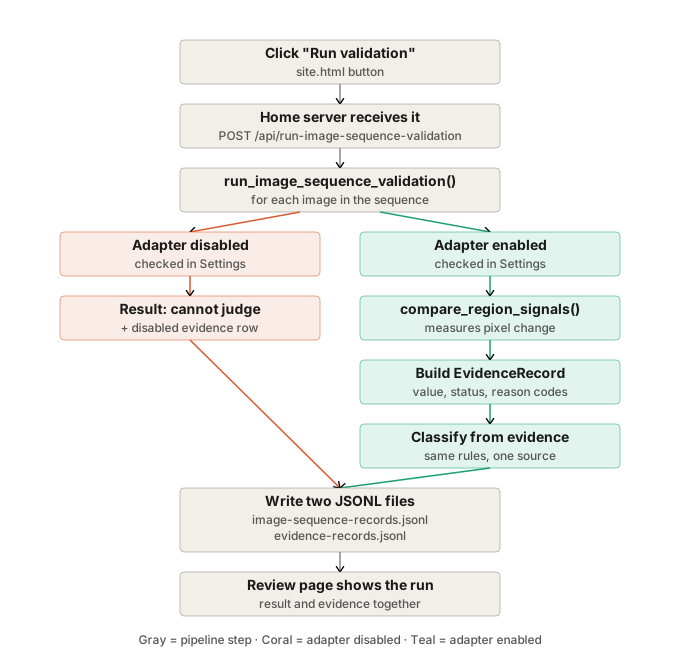
The pixel-change adapter described above is implemented
(src/openfloodai/evidence/adapters/pixel_change.py) and drives image-sequence
validation's actual row classification, not just a side-channel evidence log.
run_image_sequence_validation()
(src/openfloodai/validation/image_sequence_runner.py) builds one
EvidenceRecord per image from compare_region_signals()'s output, then
classifies that row from the evidence record instead of re-reading the raw
signals dict a second time -- one source of truth for both the row's result
and its entry in evidence-records.jsonl.
The adapter can be turned on or off globally or per site (console Settings
page, src/openfloodai/evidence/settings.py). Disabling it is not
cosmetic: the row becomes cannot_judge_water_level with an explicit reason,
never a silently-normal result -- the "missing evidence is not normal
evidence" rule from this document, enforced in the real pipeline output, not
just in the evidence contract's own validation.
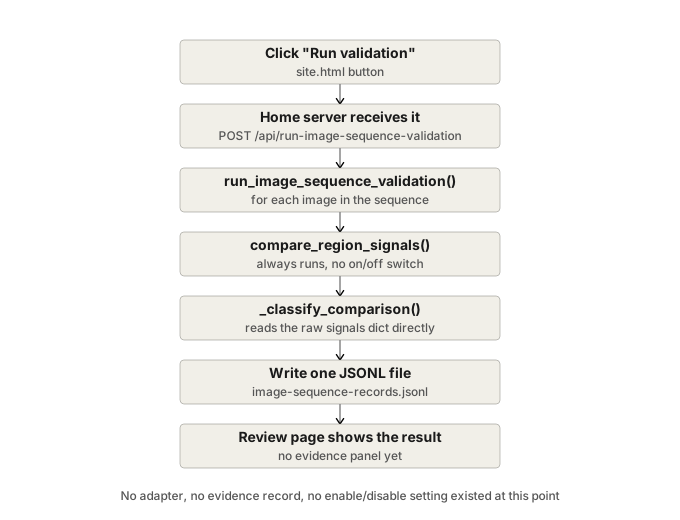
Before (original flow -- no adapter, no evidence record, nothing to enable or disable; kept here as a historical reference):
After (current flow -- classification is driven by the adapter's evidence, and can be turned off per site):
This is the first of the Steps 00-05 slices this document defers to; the
video-validation path (pipeline/local_poc.py -> risk_engine.evaluate_risk_state())
still reads raw signal dicts directly and has not been switched to this
pattern yet.
Consequences, risks, and validation evidence required
The benefit is independent evolution and graceful degradation. The cost is explicit contracts, provenance, and sufficiency policy. Principal risks are false independence, incompatible score meanings, stale context, invalid references, and confusing pipeline completion with assessment quality.
Before future implementation is accepted, demonstrate through targeted replay and failure checks that:
- Disabling each optional capability still reaches a saved human-review result.
- Zero plugins and unusable camera evidence yield
UNKNOWN_DEGRADED, notNORMAL. - A timeout or invalid record affects only that capability and its declared dependents.
- Network loss preserves local processing and exposes missing/stale remote context.
- Conflicting evidence and shared provenance remain inspectable.
- Replacing an adapter preserves the core flow; incompatible semantics are rejected or explicitly versioned and reviewed.
- Replaying fixed evidence, state, and configuration reproduces risk decisions.
- No plugin or risk output bypasses the human-review/public-warning boundary.
These are future acceptance conditions, not tests performed or passed by this documentation change. Revisit the design if measured resource contention requires isolation, multiple adapters demonstrate a real framework need, or validated requirements change the risk-policy boundary. Roll back an incompatible adapter or configuration rather than silently reinterpreting historical evidence.